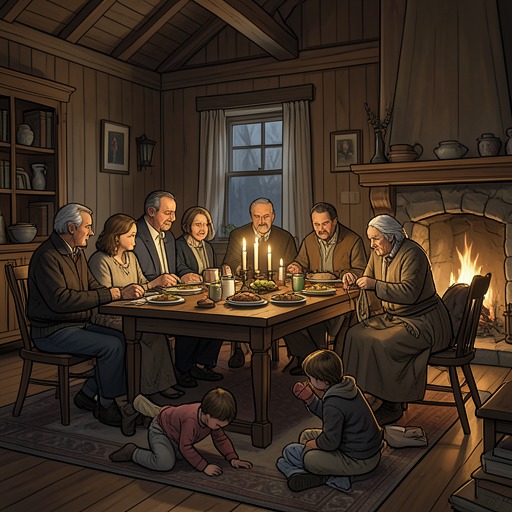
Natasha Rostova
War and PeaceNatasha Rostova is introduced as a thirteen-year-old girl whose physical awkwardness, vivid energy, and instinctive participation in every surrounding emotion make her immediately memorable. She is not presented as conventionally beautiful: her appeal lies in movement, responsiveness, and an intensity that repeatedly turns private feeling into visible action. Across the novel, that intensity carries her from childish games and first attachments through romantic idealization, betrayal, grief, and finally a demanding family life in which love is expressed less through display than through sustained care.
Identity and Introduction
Natasha first appears during her name-day celebration at the Rostov household, darting into the drawing room in a short muslin dress after running with the other young people. Her bare shoulders are heaving from exertion, her black curls have been thrown backward, and her wide-mouthed, black-eyed face is described as lively rather than conventionally pretty. The scene establishes her characteristic force: she enters accidentally, interrupts adult sociability, and makes the room answer to her vitality. Count Ilya Rostov welcomes her with open affection, while Countess Natalya Rostova reproaches him for spoiling her. Natasha therefore begins as both the beloved child of a warm household and a disruptive presence who cannot remain contained by formal manners.
Her curiosity is physical and theatrical. Hiding among the tubs in the conservatory, she watches Sonya Rostova and Nikolai Rostov reconcile, scarcely breathing and following their intimacy with sparkling eyes. The scene gives her an early education in emotional life, but it is not detached observation. She immediately converts what she has witnessed into a test of her own feelings. She calls Boris Drubetskoy into the conservatory, proposes that he kiss a doll and then asks whether he would kiss her, making the encounter a mixture of play, fear, solemnity, and experiment.
When Boris hesitates, Natasha climbs onto a tub, embraces him around the neck, and kisses him full on the lips. Boris tells her that he loves her but asks her to wait four years before he seeks her hand. Natasha counts the years on her fingers and accepts the arrangement, demanding that it be settled forever, even until death. The promise is childish in its arithmetic and absolute in its language. It shows both her capacity to invest an instant with lifelong meaning and the emotional seriousness concealed within her apparently impulsive behavior.
Love, Desire, and Moral Error
Natasha's later entrance into adult society retains the same bodily immediacy but places it under more consequential pressures. At the imperial ball, she is distressed because she has not yet been asked to dance. Pierre Bezukhov notices her despair and urges Prince Andrei Bolkonsky to invite her. Prince Andrei recognizes that it is her debut and approaches her with pleasure. The invitation transforms her face from threatened tears into a grateful, childlike smile, and the two dance as the second couple on the floor. Her happiness is not merely narrated as an idea: it is carried by the quick, independent movement of her feet and by the radiance of her face.
Her relationship with Prince Andrei develops from this encounter into a promise of marriage. When he asks for her hand, Natasha is pale, dry-eyed, and praying before the icons. She experiences the proposal as a passage out of childhood: the girl once dismissed as a mere child imagines becoming the wife and equal of a man admired even by her father, and understands that her words and actions will now bear adult responsibility. Prince Andrei's feeling also changes at the moment of commitment. His earlier poetic attraction is replaced by pity, fear for her trustfulness, and a serious, joyful sense of duty. Their engagement thus joins mutual love to a delay of one year, a separation that leaves Natasha vulnerable to the difference between emotional immediacy and sustained judgment.
During that interval Natasha is drawn toward Anatole Kuragin. A private encounter leaves her physically shaken and unable to interpret what has occurred. Anatole presses his lips to hers, repeats that he wants one word from her, and offers no explanation capable of resolving the scene. The Rostovs leave before supper, and Natasha passes the night tormented by the belief that she loves both Anatole and Prince Andrei. Her confusion is not presented as a simple change of allegiance: she remembers the depth of her love for Prince Andrei while also treating the fact that she returned Anatole's smile and allowed the encounter to proceed as proof that she must have loved Anatole from the beginning.
The attempted elopement with Anatole becomes a decisive moral and emotional crisis. Natasha's error damages her engagement and forces her to confront the consequences of treating intense sensation as reliable knowledge. Yet the narrative does not reduce her to deceit or frivolity. Her distress is expressed as shame, uncertainty, and a desperate need to understand what she has done. When she speaks with Pierre, she insists that Anatole not simply be called bad, even while admitting that she does not know whether she loved him. Her inability to give a clean moral explanation becomes part of the novel's larger distinction between experience and self-justifying interpretation.
Relationships and Compassion
Natasha's earliest bonds reveal her tendency to treat affection as an all-encompassing pledge. In the conservatory, she observes the reconciliation between Nikolai and Sonya, then seeks Boris with the same mixture of daring and vulnerability. Her relationships with Sonya and Boris belong to a world in which love can be enacted as a game, yet the game already contains genuine promises and fears. Natasha's emotional life grows by carrying those early forms of attachment into adult situations where the stakes are no longer symbolic.
Her bond with Prince Andrei is the central romantic development of her early adulthood. The ball allows him to see the emotional life beneath her social anxiety, while Natasha experiences his invitation as recognition. Their proposal scene reverses the earlier playful kiss with Boris: Natasha now approaches love through prayer, trembling seriousness, and the recognition of responsibility. The relationship is broken by her involvement with Anatole, but its importance remains visible in her later grief and in the understanding that she shares with Princess Marya Bolkonskaya.
Pierre becomes the person who responds to Natasha's collapse without exploiting it. When she confesses her shame and asks that Prince Andrei forgive her, Pierre is overwhelmed by a pity, tenderness, and love he has not previously known. He promises to tell Prince Andrei everything and offers himself as a friend who can provide help, advice, or simply a place in which she may speak when her mind is clearer. His declaration that, if he were free and the best man in the world, he would immediately ask for her hand restores to Natasha not romance in the immediate sense but the possibility of a future. She leaves him weeping tears of gratitude and tenderness.
Natasha's compassion becomes most visible in the aftermath of war. At night she enters the room where Prince Andrei lies wounded. Timokhin is suffering from a wounded leg, while a doctor and a valet sleep on the floor; Natasha approaches through this crowded, painful space until she sees Prince Andrei clearly. His feverish face and childlike appearance alter her perception of him, and she drops to her knees when he extends his hand. The scene turns her former romantic idealization into active recognition of vulnerability. Love is no longer primarily the ecstatic feeling of being chosen; it is the willingness to move toward a damaged body and remain present before suffering.
Her meeting with Princess Marya after the destruction and displacement caused by war completes this movement toward self-forgetting care. Princess Marya initially knows Natasha as the young woman she had disliked, but one glance at Natasha's face reveals a true companion in grief. Natasha leaves Prince Andrei's bedside to meet her, embraces her, and leads her back to him. Her face expresses love for Prince Andrei, for Princess Marya, and for everything near him, together with pity and a passionate desire to give herself to helping others. Princess Marya understands that Natasha is not thinking of herself or of the status of her own relationship with Prince Andrei. Their friendship is therefore founded not on explanation but on shared suffering and immediate service.
Family Transformation and Ending
The later Natasha is radically different in outward form from the lively girl of the name-day scene. She marries in the early spring of 1813, and by 1820 has three daughters and a long-desired son whom she is nursing. Her body has become stout, broad, strong, handsome, and fertile; her formerly slim figure is difficult to recognize. The transformation is deliberately concrete, and it carries a social as well as physical meaning: motherhood, pregnancy, confinement, nursing, and the continuous demands of family life have reorganized her existence.
Her old animation has not simply vanished, but it has become rare and situational. The fire returns when her husband comes home, when a sick child recovers, when she and Countess Mary discuss Prince Andrei, or on the uncommon occasions when she sings, a practice she has abandoned since marriage. In those moments she is described as even more attractive than before. The change is therefore not a straightforward extinguishing of vitality. The earlier brilliance has been absorbed into attachments that require constancy, and it appears when those attachments are touched.
Natasha and Pierre live in Moscow, Saint Petersburg, on an estate near Moscow, or in the household of Countess Mary’s brother, Nikolai Rostov. Natasha is seldom seen in society, and those who encounter her there do not find her attractive or amiable. Her withdrawal is not explained as a settled preference for solitude; rather, she is unsure whether she likes solitude at all, while the practical demands of pregnancy, childbirth, nursing, and sharing every moment of Pierre's life leave little room for public existence. Her ending thus rejects a purely social definition of fulfillment. The girl whose presence once electrified rooms becomes a woman whose life is concentrated in intimate, repetitive, embodied labor.
Narrative Significance
Natasha's trajectory gives emotional form to the novel's movement from spectacle toward responsibility. As a girl, she experiences life through sudden entrances, games, dances, kisses, and promises made in the language of forever. As a young woman, the same intensity produces both genuine love and destructive confusion. Her involvement with Anatole exposes the danger of confusing immediate emotional force with moral truth, but her subsequent shame and compassion prevent the episode from becoming a final definition of her character.
She is a round character because her changes are neither cosmetic nor predictable. The impulsive child becomes an adult capable of grave error; the romantic fiancée becomes a penitent and compassionate presence beside a dying man; the socially radiant young woman becomes a mother whose identity is largely expressed through care. The final Natasha is less visible to society but not less alive. Her strongest feelings now circulate through her husband, children, Princess Marya, and the memory of Prince Andrei. The novel's decisive judgment on her is therefore embodied in transformation: Natasha does not preserve her youthful animation unchanged, but turns its energy into attachment, endurance, and the daily work of sustaining a family.